Google has been dominating the SERP since its inception, but that power may be crumbling. Four years ago, Google held 93% of the search market share, but now decreased to 90%. That might not seem like a lot, but when you look at their competition that has grown by similar intervals, we start to wonder if people are turning away from the search giant.
But what has caused this decline? How could Google take such steps backwards? In this article, we’ll explore how the changes in Google’s corporate priorities have impacted their search results and ad network, and what you should do to protect your site traffic.
Code Yellow
The impetus behind Google’s decline relates back to their corporate policies which impact how their search and ads teams work together. For decades, these teams were kept separate to ensure the SERP didn’t become oversaturated with commercial efforts, and decrease the end user experience. The goals of these teams were different: the search team was focused on increasing the volume of searchers and keeping them on Google, while the ads team focused on revenue.
Then Code Yellow changed everything.
Code Yellow was Google’s response to running short of their earrings goal in 2019. As a result they shuffled people within the search and ads teams which blurred the lines between these two verticals.
In Google’s current lawsuit with the Department of Justice, an email has surfaced from Ben Gomes the former head of Google Search, to the heads of the ads team at Google to discuss the angst between the two teams. Gomes’ primary concern was that some of the changes the ad team was pushing, while profitable in the short term, would impact the end user negatively. And the results are becoming apparent on the SERP.
Changes in Organic Search Results
Organic search has changed over the last few years. With the increase in forum results and addition of AI generated answers (Search Generative Experience) Google’s SERP is not the same. Further the way consumers are searching has changed with more emphasis on platforms like TikTok and Pinterest. It might make sense that social based platforms, but then why is Bing’s usage increasing 27% over the last five years?
Users across Reddit, TikTok, and YouTube are citing the reasoning behind Google’s waning dominance is the decline in quality search results. Five years ago there were opportunities for smaller sites to rank on Google with quality, well researched, content that answered the searcher’s query. The People Also Ask search feature only helped improve the chances of finding exactly what you were looking for.
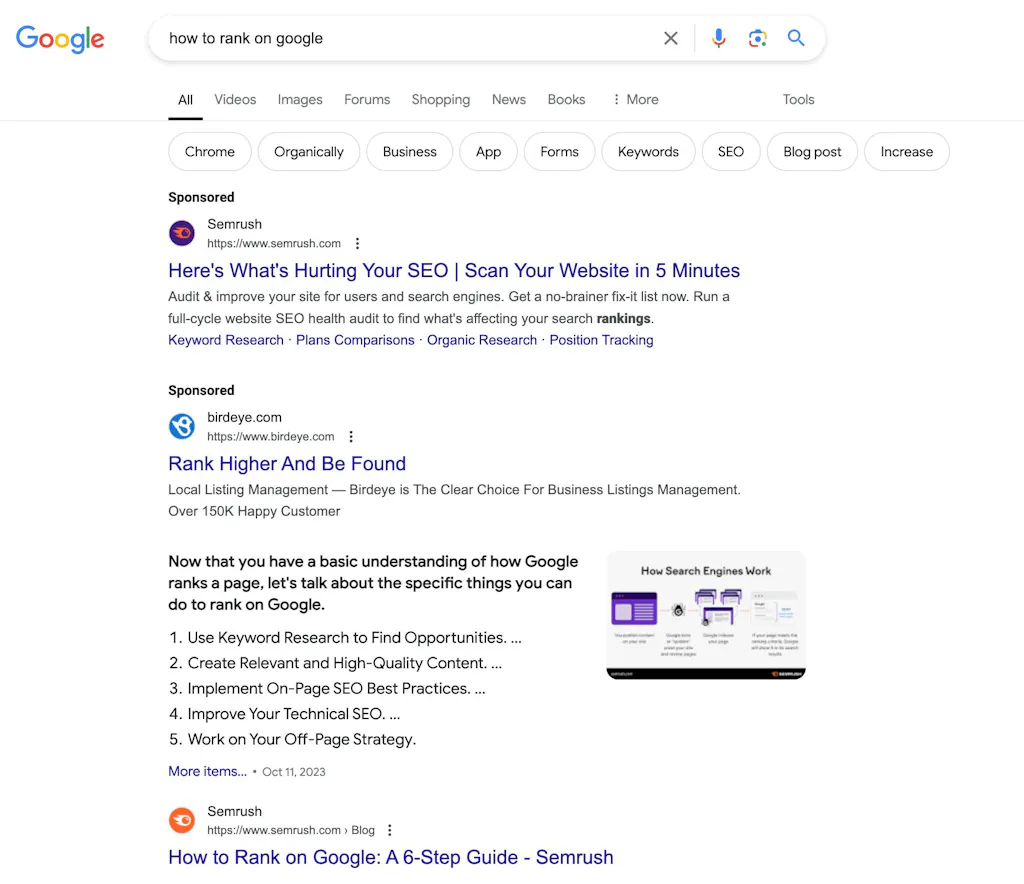
Between the increased ad space, SGE results, forum results, and other search features it’s almost impossible to rank on page one as a small site. In fact, for the below query “how to rank on Google”, there are only four organic results on page one that don’t fall into those categories. And those are all written by industry giants.
It could be argued that the reasoning behind this is because Google is providing the most relevant results for a highly competitive term, however, that doesn’t explain the multiple Reddit results that appear higher than the organic content, and the fact that the space above the scroll is all ads. It’s clear that Google is prioritizing revenue over user experience, and we predict this is going to cost them in the long-run.
Consumers are already fleeing to Bing which once held only 2.5% of the search market share, and now holds 3.6%. But Bing is hardly the biggest threat to Google. 40% of people use TikTok for information , and Pinterest continues to see YoY growth with a 23% jump just from 2023.
As Google continues to fight to capture more revenue, it’s once insignificant competitors are capturing the market share. Now with Open AI’s ChatGPT being used by 14% of Americans , Google faces its biggest challenge yet.
Changes in Paid Search Trends
But Google’s problems are far from being isolated to their organic search results. Marketers on the paid advertisement side are growing frustrated with Google as well. While more space for ads might make one assume advertisers are gaining more performance for their dollars, few are talking about the benefits these SERP changes have brought about.
Previously, the denotation for an ad vs. an organic result was clear. Ads had fewer characters, they had a little green box clearly identifying them as a promotion, and were in a box of their own. Now, aside from small black text that says “sponsored” ads tend to blend in with the organic results. According to Wordstream, consumers are 37% less likely to click on an ad today than they were five years ago. The change in SERP real estate does not appear to be helping advertisers.
Further, the increase of ad placements on Google makes this decrease in CTR even more concerning as consumers have to scroll even further to get past the ads. The fact they are clicking at lower volumes than ever has sparked an interesting discussion among advertisers who’ve noticed CPCs rising by 12% in this same time period.
In 2023, Search Engine Land reported that Google confirmed they do inflate costs between 5 to 10% per auction. Marketers have long suspected Google manipulating these costs, and with the introduction of new AI based bidding, Google’s transparency has decreased. When managing accounts with tight budgets, it’s often terrifying that Google can decide to spend double your budget, and sometimes more, when it “sees opportunity”. This becomes even more concerning when there is little to no return from this spike and it automatically sacrifices spend on another, potentially lucrative, day.
What Should Brands Do About This
Brands everywhere are bracing for a decrease in traffic, praying that Google’s updates will somehow result in higher quality. For those leveraging Google Ads, they are at the mercy of Google’s blackbox automations to hopefully guide their campaigns to stronger performance. But at Media Proper, we’re taking actions to help our clients mitigate the decline in Google search dominance.
First, we’re not encouraging our clients to capitalize on platforms such as Reddit or Quora just to increase their rank. While forums are great for connecting and sharing ideas and information, they are not a great resource for information as most of it is tinged with opinion which decreases the accuracy.
Second, we believe in media diversification. When we can, we always recommend our clients invest in creating video and audio content. Google is already showing video in the search results and users can find the information through platforms such as YouTube and TikTok. Pinterest and other social media platforms are great additional ways of capturing search traffic as more and more people stray from Google.
And finally, we have been encouraging our clients to explore new platforms for their paid assets as well. Competition and CPCs remain less expensive on Bing, and have just as much opportunity to drive strong results. Similar to organic, we’re also encouraging our clients to explore social platforms such as Pinterest, NextDoor, YouTube and TikTok according to their brand. This will allow them new avenues of traffic to make up for the areas Google may be falling behind in.
Google’s absolute reign over search may be fading, but there are ways you can navigate this so your traffic doesn’t evaporate. Now, more than ever, it’s important to understand how to optimize your content beyond text and the technical backend. This means moving more towards video and optimizing for social SEO. On the advertising side, you need to explore other mediums beyond Google Ads. Finding success on other platforms such as Microsoft and Pinterest can make a huge difference as more and more people start to explore other search avenues.
While all this might seem overwhelming, it can help to discuss new tests with your agency partners. Understanding the changes in the industry will be key as you guide this discussion. Your agency should be well versed in these digital nuances and together you can protect your traffic from the massive search evolution.
Contact Media Proper for your digital marketing needs!
Sources
YoY stats
Benchmarks
Google accused of price manipulation
Historic Google Benchmarks